
In the previous two articles, we discussed why checking your portfolio every day usually leads to unnecessary decisions and why a thoughtful annual review is often enough to keep your financial plan on track.
That naturally leads to the next question.
If I review my portfolio only once a year, how should I actually keep track of it?
Today, there are countless portfolio tracking apps and websites. Most automatically import your investments, calculate returns and display colourful dashboards filled with charts.
They are convenient.
But before choosing one, I would encourage you to consider something different.
Build your own.
It may take an hour to build, but you’ll probably use it for decades.
Not because it will be more powerful than the available apps.
But because the process of building it can be more valuable than the tracker itself.
Why Build Your Own Portfolio Tracker?
The purpose of a portfolio tracker is not to tell you how much your portfolio moved today.
Its purpose is to help you make better decisions during your annual review.
Building your own tracker gives you something most apps cannot provide: a system designed around your own financial goals.
Most portfolio apps assume every investor wants to track the same things—daily returns, XIRR, rankings and performance charts.
But your priorities may be completely different.
Perhaps your biggest concern is whether you are on track to fund your child’s education or achieve financial independence(see why personal finance starts with you), rather than whether one mutual fund outperformed another by 2%.
When you build your own tracker, you decide what deserves your attention.
More importantly, the process itself improves your understanding of your finances.
As you create goals, assign investments and decide what information belongs in your tracker, you naturally start asking better questions.
Why do I own this investment?
Which goal does it support?
How much risk was I originally comfortable taking?
The exercise creates clarity and ownership.
Instead of relying entirely on a dashboard created for everyone, you build a system that reflects your own financial journey.
Your tracker can also evolve as your life changes.
There is no perfect template.
The best tracker is the one that helps you understand your progress and make better decisions.
A Simple Portfolio Tracker
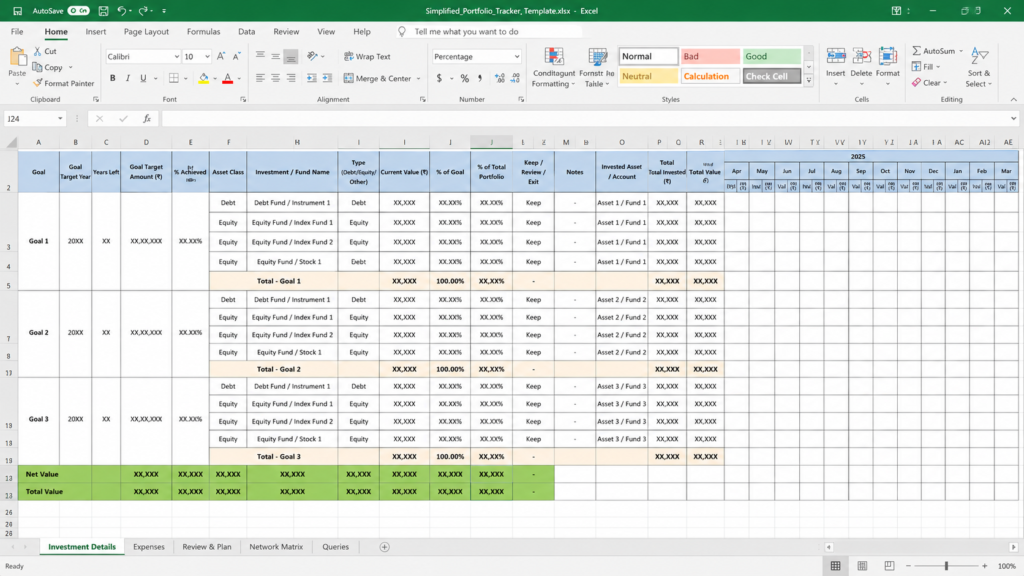
At first glance, this may look like an ordinary spreadsheet.
But every section exists for a reason.
The most important difference is that the tracker is organised around financial goals, not investments.
Each goal has its own section showing:
- Target amount
- Target year
- Current value
- Percentage achieved
- Years remaining
Under each goal, both equity and debt investments are listed. If a goal has multiple equity funds, simply add another row.
The objective is not to count how many mutual funds you own.
It is to understand whether each financial goal is progressing according to plan.
If you add a new goal in the future, the tracker helps you understand how it affects your existing goals, monthly investments and your overall financial plan.
Notice What’s Missing
You will also notice what is not included. There are no fund-level XIRRs. No CAGR comparisons. No rankings of your best-performing funds. No colorful performance dashboards. That is intentional.
The purpose of this tracker is not to constantly compare investments or encourage unnecessary changes.
Those numbers are already available through your investment platform or your Consolidated Account Statement (CAS).
If you decide to review fund performance, let that be one of the final steps in your annual review—not the first.
Begin with a more important question:
“Is my portfolio helping me achieve my financial goals?”
That single question changes the way you review your investments.
Asset Allocation Becomes Easier to Review
Each goal also displays its current equity and debt allocation.
During your annual review, compare this with the allocation you originally planned.
Then ask yourself:
- Does it still reflect the years remaining for this goal?
- How much of the goal has already been achieved?
- Am I taking more or less risk than I originally intended?
Instead of reacting to market movements, you are simply checking whether your portfolio still matches your financial plan.
That is a much more meaningful discussion.
A Record of Consistency
Each month, record how much you have invested.
Over time, your tracker becomes more than a spreadsheet. It becomes a record of your consistency.
Looking back after several years, you will see not only how your portfolio grew, but also how your investing habits evolved.
A Snapshot of Your Financial Progress
The summary section brings everything together.
Instead of focusing on today’s gains or losses, it answers a more useful question:
“Am I closer to my financial goals than I was last year?”
For a long-term investor, that is often the only question that really matters.
Don’t Forget the Second Worksheet
The second worksheet is intentionally simple.
It is not about investments.
It is about organisation.
Use it to maintain important financial information such as:
- Bank accounts
- Mutual fund platforms
- Demat accounts
- EPF and PPF accounts
- Insurance policies
- Loan details
- Nominee information
- Important contacts
Hopefully, nobody else ever needs to use it.
But if something unexpected happens, your family should not have to search through emails, paperwork and multiple apps trying to understand your finances.
Keeping important information in one place can make things much easier for them.
Go One Step Further: Write an Annual Portfolio Audit
Your tracker records the numbers.
Your annual audit records the decisions.
Think of it as a short letter to your future self.
The tracker tells you what changed.
The audit explains why it changed.
A year later, you will know exactly why you increased your investments, skipped a rebalance, postponed a financial goal or decided not to make any changes.
Over time, these audits become one of the most valuable parts of your financial records because they capture your thinking while it is still fresh.
What Should an Annual Audit Include?
It does not need to be lengthy.
One or two pages every year is usually enough.
Start with a simple summary of the year.
Review:
- How much did your portfolio grow?
- How much did you invest compared to last year?
- Did you increase your monthly investments?
- Did you add any new financial goals?
- Did you rebalance your portfolio?
- Did your emergency fund or insurance require any updates?
Then review each financial goal individually.
Record your current progress, whether the asset allocation still matches your original plan and whether any action is required.
Finally, write down the important financial decisions you made during the year and the action items for the following year.
Five years from now, you will remember not only what changed—but why.
Below is a simple example.
Annual Portfolio Audit – 2026 (Example)
Overall Portfolio Summary
Overall portfolio value increased from ₹48.5 lakh to ₹61.2 lakh.
Total investments during the year were ₹9.6 lakh, compared with ₹8.4 lakh last year.
Monthly investments were increased after the annual salary revision.
Overall progress towards financial goals improved from 36% to 44%.
No new financial goals were added during the year.
No significant rebalancing was required.
Insurance policies and nominee details were reviewed.
Emergency fund remains fully funded.
Goal Review – Child’s Education
Target Amount: ₹1.20 Crore
Target Year: 2038
Current Progress: ₹18.4 lakh (15%)
Years Remaining: 12
Review
Current asset allocation remains close to the planned allocation.
Monthly investments continued without interruption.
The goal remains on track.
Decision
No changes required this year.
Review again during next year’s annual portfolio review.
Goal Review – Retirement
Target Amount: ₹4 Crore
Target Year: 2052
Current Progress: ₹82 lakh
Review
Monthly investments were increased after the salary revision.
The existing investment strategy continues to support the objective.
Decision
Increase monthly SIP by ₹5,000 next year.
Major Financial Decisions This Year
• Increased monthly investments.
• Reviewed insurance coverage.
• Updated nominee information.
• Continued with the existing investment strategy.
• Decided not to rebalance because the deviation from the target allocation was insignificant.
Action Items for Next Year
• Increase investments after the next salary revision.
• Review retirement assumptions.
• Update target values for inflation.
• Review insurance coverage.
• Complete the annual portfolio review.
There Is No Perfect Tracker
Before you download the template, remember one thing. This is not the perfect portfolio tracker.
It was never meant to be. The same applies to the annual audit. Both should evolve with your financial journey. When you first start investing, you may only track your goals, investments and asset allocation.
As your financial life becomes more complex, you may choose to add other details:
- Annual increases in investments
- Salary growth
- Major financial decisions
- Lessons learnt during each year’s review
Every investor’s journey is different. Your tracker should reflect that. Eventually, it becomes a record of your financial life rather than just another spreadsheet.
When you look back after ten or fifteen years, you will see much more than portfolio returns. You will see the goals you achieved. The habits you built. The decisions you made. And the consistency that helped you get there.
One Final Thought
In the first article of this series, we discussed why a portfolio should not change because of a conversation during an office tea break, a television expert or a social media post.
This article completes that idea.
You now have a simple system to review your portfolio once a year, track your progress towards your financial goals and record the reasoning behind your financial decisions.
A good portfolio tracker is not the one with the most charts, formulas or features.
It is the one that helps you make thoughtful decisions once a year—and then gives you the confidence to leave your portfolio alone for the other 364 days.
Because successful investing is not about constantly watching your portfolio.
It is about building a process you trust, following it consistently and allowing time to do the heavy lifting.
If this template helps you begin that journey, change it.
Make it your own.
Years from now, you may find that your spreadsheet tells a much richer story than your portfolio returns ever could.
Download the SimpliFinSriram Goal-Based Portfolio Tracker
A simple spreadsheet designed to help you review your portfolio annually, track progress towards your financial goals and record the decisions that matter most.
Portfolio_Tracker_Template_SimpliFinSriram –
Disclaimer: This article is intended for educational and informational purposes only and reflects my personal research and opinions. It should not be considered personalized investment, tax, or legal advice. Please consult a qualified professional before making financial decisions. Read the full Disclaimer.